
Dental Bridges Falling Down: What Causes Them to Fail?
November 6, 2025
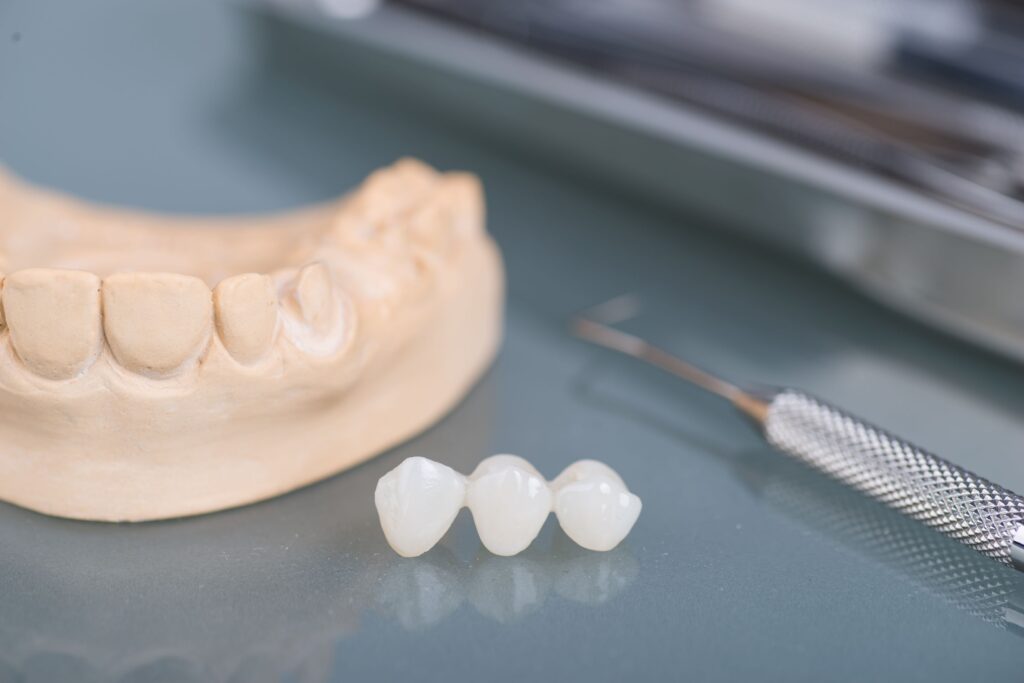
If you’re missing one or several teeth in a row and want to rebuild your smile, you might benefit from a dental bridge. These restorations contain the required number of pontics (artificial teeth) between a dental crown on each end. They are cemented over healthy enamel or dental implants to close the gap in your grin.
However, you must care for your prosthetic properly after it’s placed to prevent potential complications. If you’re unsure how your dental bridge might be harmed, continue reading to learn about 3 things that could cause it to fail!
Cause #1: Poor Oral Hygiene
Dental bridges rely on abutment teeth or dental implants on each side of the space in your smile to hold them in place. That means you must have sufficiently healthy enamel and/or connective tissues for them to remain stable and in good condition.
Unfortunately, if you develop dental problems, such as cavities or gum disease, the tissues holding your pearly whites in place might erode, leaving your prosthetic without a firm enough foundation to remain put. You can prevent this by brushing and flossing twice daily to remove plaque and bacteria that contribute to common oral concerns.
Cause #2: Bad Habits
These oral appliances are usually made from customizable ceramic that’s less porous than your enamel. As a result, it is usually less prone to chipping, cracking, and staining. But that doesn’t mean it’s invincible! If you indulge in certain bad habits, you could potentially damage the material your new teeth are made from.
For instance, subconsciously grinding your teeth (bruxism) or anxiously nibbling your fingernails or pen caps could harm your dental bridge. Unfortunately, any injury that affects its structure allows germs to penetrate the enamel and gums it’s anchored to more easily, increasing the likelihood of failure.
Cause #3: Tooth Decay
Traditional dental bridges are anchored to healthy teeth on each side of the gap in your grin, but for them to fit correctly, your dentist must remove some of the enamel from these supports. This slightly weakens the underlying teeth, and although your restoration can help shield them once it’s cemented in place, bacteria can still penetrate underneath your bridge to affect them.
If these abutments develop cavities, your restoration can become loose or destabilized because there’s not enough healthy material anchoring it in place. This significantly increases the likelihood that it will eventually become entirely dislodged.
If you’re concerned that your dental bridge may be failing, your dentist can examine your condition and recommend appropriate repairs or suggest a more reliable solution, such as dental implants.
Meet the Author
Dr. Bob Heil has 20+ years of experience helping people of all ages build and maintain the healthiest and most beautiful versions of their smiles. He earned his Doctor of Dental Surgery from the University of Minnesota and stays current with contemporary treatments and technology by participating in professional organizations, such as the American Dental Association. Today, he offers a comprehensive menu of services, including dental bridges, to meet all your family’s needs conveniently under one roof. You can request an appointment on the website or by calling (920) 235-0320.
No Comments
No comments yet.
RSS feed for comments on this post.
Sorry, the comment form is closed at this time.